An early demonstration of Su Dong Chen doing Xingyi. I love the clarity in his demonstrations.
Showing posts with label Baguazhang. Show all posts
Showing posts with label Baguazhang. Show all posts
Saturday, May 18, 2013

Thursday, April 25, 2013
Classes resuming Tuesday 4/30!
My public classes in Gao style Bagua are resuming for the summer next Tuesday, 4/30!
We will be focused on key elements of the hand and body usage in Bagua.
Please let m know if you'd like to join - the first class is always on me!
We will be focused on key elements of the hand and body usage in Bagua.
Please let m know if you'd like to join - the first class is always on me!
Friday, January 13, 2012
Bagua/ Xingyi Seminar Boulder, CO Feb 25 & 26
Hello Everyone,
Boulder Internal Arts is hosting Matt Autrey for another awesome weekend of Bagua and Xingyi here in Boulder, CO February 25th & 26th.
I will send another email when i have exact times and places.
If you have any other questions please contact me.
Matt Autrey
*Senior Student of Luo De Xiu of Taiwan*
![]()
*Boulder, CO. February 25th & 26th *
Matt Autrey is a senior student of Yi Zong teacher Luo De Xiu. Matt has just moved back to the United States after 8 years of training Bagua Zhang, Xingyi Quan, Tai Ji Quan in Taipei, Taiwan including 5 years with Marcus Brinkman as a private student. Matt spent many years teaching and assisting in Luo Laoshi’s class in Taiwan, his extensive knowledge and command of the internal martial arts is an asset to any practitioner.
Boulder, CO. Dates and Curriculum:
Saturday, February 25th Morning Session
Xing Yi 5 Elements Kicking – Theory and Application
This will be an excellent introduction to the Xing Yi Quan kicking methods of Hong Yi Xiang. Learn fundamental training practices, footwork, and applications of the Wu Xing (5 Elements) kicking methods. This seminar is open to public and beginners are welcome.
Saturday, February 25th Afternoon Session
Bagua Zhang - Lao San Zhang: Three Old Palms - Theory & Practice
In this seminar Matt will cover the Lao San Zhang (Three Old Palms). The Lao San Zhang (Three Old Palms) will cover traditional Cheng Ting Hua style Bagua theory as it relates to Gao Style and Sun Xi Kun Xiantian (pre-heaven) Bagua as well as its influence on Gao Style Hou Tian. This seminar is a great introduction to Ba Gua Zhang in general and the Gao system in particular. This seminar is open to public and beginners are welcome.
Sunday, February 26th Morning Session
Xing Yi Fa Jin Training – Power Development for the Five Fists
Matt will be teaching Fa Jin forms and exercises used to develop power for the Xingyi 5 Elements. He will also teach applications and fighting strategies for power usage in Xingyi Quan. Previous knowledge of the Xing Yi 5 Elements is recommended.
Sunday, February 26th Afternoon Session
Bagua Zhang Skill Building – 2 Man Drills
The Gao style Bagua Hou Tian, post-heaven, palm forms are a unique feature of Gao Yi Sheng’s Bagua Zhang system; they are preformed in a straight line with emphasis on combat application. These two person training drills will help build reflexes, timing and distance required for the usage of Bagua in a combat setting. This seminar is open to public and beginners are welcome.
Cost:
1 $175 for all Four Sessions!
2 Individually, Each Session is $50.
3 Saturday & Sunday $95 each day or $175 for both Days.
4 Preferred payment is cash (please contact if paying by check)
5 Same day registration (call for availability) $180 cash only
FOR PRICING INFO AND LOCATION EMAIL:
Owen Schilling at mailto:Owen_YiZong@Hotmail.com
Or Check http://boulderinternalmartialarts.blogspot.com/or Call 1 720 841 2404
Matt will be offering private lessons while he is in town. I highly recommend them; his knowledge and skill applied at the individual level is a fantastic catalyst for growth. Contact me or Matt at yizongwest@gmail.com or talk to him at the seminar. For more info on Matt check his blog: yizongwest.blogspot.com
Boulder Internal Arts is hosting Matt Autrey for another awesome weekend of Bagua and Xingyi here in Boulder, CO February 25th & 26th.
I will send another email when i have exact times and places.
If you have any other questions please contact me.
Matt Autrey
*Senior Student of Luo De Xiu of Taiwan*
*Boulder, CO. February 25th & 26th *
Matt Autrey is a senior student of Yi Zong teacher Luo De Xiu. Matt has just moved back to the United States after 8 years of training Bagua Zhang, Xingyi Quan, Tai Ji Quan in Taipei, Taiwan including 5 years with Marcus Brinkman as a private student. Matt spent many years teaching and assisting in Luo Laoshi’s class in Taiwan, his extensive knowledge and command of the internal martial arts is an asset to any practitioner.
Boulder, CO. Dates and Curriculum:
Saturday, February 25th Morning Session
Xing Yi 5 Elements Kicking – Theory and Application
This will be an excellent introduction to the Xing Yi Quan kicking methods of Hong Yi Xiang. Learn fundamental training practices, footwork, and applications of the Wu Xing (5 Elements) kicking methods. This seminar is open to public and beginners are welcome.
Saturday, February 25th Afternoon Session
Bagua Zhang - Lao San Zhang: Three Old Palms - Theory & Practice
In this seminar Matt will cover the Lao San Zhang (Three Old Palms). The Lao San Zhang (Three Old Palms) will cover traditional Cheng Ting Hua style Bagua theory as it relates to Gao Style and Sun Xi Kun Xiantian (pre-heaven) Bagua as well as its influence on Gao Style Hou Tian. This seminar is a great introduction to Ba Gua Zhang in general and the Gao system in particular. This seminar is open to public and beginners are welcome.
Sunday, February 26th Morning Session
Xing Yi Fa Jin Training – Power Development for the Five Fists
Matt will be teaching Fa Jin forms and exercises used to develop power for the Xingyi 5 Elements. He will also teach applications and fighting strategies for power usage in Xingyi Quan. Previous knowledge of the Xing Yi 5 Elements is recommended.
Sunday, February 26th Afternoon Session
Bagua Zhang Skill Building – 2 Man Drills
The Gao style Bagua Hou Tian, post-heaven, palm forms are a unique feature of Gao Yi Sheng’s Bagua Zhang system; they are preformed in a straight line with emphasis on combat application. These two person training drills will help build reflexes, timing and distance required for the usage of Bagua in a combat setting. This seminar is open to public and beginners are welcome.
Cost:
1 $175 for all Four Sessions!
2 Individually, Each Session is $50.
3 Saturday & Sunday $95 each day or $175 for both Days.
4 Preferred payment is cash (please contact if paying by check)
5 Same day registration (call for availability) $180 cash only
FOR PRICING INFO AND LOCATION EMAIL:
Owen Schilling at mailto:Owen_YiZong@Hotmail.com
Or Check http://boulderinternalmartialarts.blogspot.com/or Call 1 720 841 2404
Matt will be offering private lessons while he is in town. I highly recommend them; his knowledge and skill applied at the individual level is a fantastic catalyst for growth. Contact me or Matt at yizongwest@gmail.com or talk to him at the seminar. For more info on Matt check his blog: yizongwest.blogspot.com
Monday, January 2, 2012
Saturday, December 17, 2011
Luo Dexiu & Ed Hines Yizong Demo!
An excellent demo of Yizong Bagua and Xingyi from Ed Hines and Luo Dexiu. I really like the full speed demo Luo does of Xingyi Bashi!
Friday, September 30, 2011
Happy Friday!
Here's hoping that I move this well when I am old. A cool little clip of Liu Hung Cheih.
Saturday, September 17, 2011
Denver Luo De Xiu Seminars, 2011

Last weekend we were privileged to have an incredible four days of workshops with Luo De Xiu of Taipei, Taiwan.
I am always blown away by Luo Laoshi's ability to transmit knowledge to people no matter where their skill level is. I have seen people that are relative beginners to Yi Zong arts come away impressed by how much they have improved in the span of a few hours. The more experienced people have much to gain as well, even if it is material you have been training for a decade or more there is always some new insight to be had. Hell, I have even seen people that don't even train in our school have a great time and learn tons!

This year I had the pleasure of seeing the Xing Yi Ba Shi form for the first time. This form is a mix of four of the five elements and four of the twelve animals. It uses Beng (crushing), Tsuan (drilling), Pao (pounding), and Heng (crossing) along with Chicken, Swallow, Horse and Sparrow Hawk. The form is very dynamic and definitely more advanced in how it is done than the other Xing Yi linking forms that I have learned.
As is typical with Luo Laoshi's seminars, there was a tremendous amount of application work. The form was broken into three sections. Each section was loaded with clear and effective applications!
I really appreciate how Luo Laoshi can clearly demonstrate the difference between the Xing Yi, Bagua and Taiji that we do in the Yi Zong school.
On Saturday, we did the first line of the Houtian palms. I have been doing this set of forms and their applications for at least 10 years now and I still picked up some invaluable information. Luo Laoshi was touching on the use of the circles found in the single palm change that are contained within first line of the Hou Tian palms. For me personally I got a lot of mileage out of this.
On Sunday Luo Laoshi presented two different subjects. In the early part of the afternoon we worked on the first three of line eight of the Hou Tian palms. The second portion of the day was spent focusing on Su Ping Tui Shou.
I have not had the opportunity to learn any of the eighth line from Luo Laoshi. The eighth line focuses on the changing of the mind and is largely intent driven. The three forms that we worked on were Bear, Badger, and Monkey. The applications were sweet! Bear has some powerful crashing and arm trapping techniques. The Badger contained some nasty, close in drilling type of striking. The monkey was intersting in how it sucks in the power of the opponent away and returns it viciously.
The Su Ping Tui Shou part of the day was intense and incredibly insightful. Luo Laoshi use of small refined circles is incredible. The layered approach that he took to teaching this workshop was great! We started with some simplified single hand methods and then progressed to simplified body methods. These were eventually fused together as we progressed into the actual format of Tui Shou that we do. At this point we were shown several ways to apply techniques from the Tui Shou format.
On Monday we wrapped up with the Wu Lung Bai Wei palms. This set of forms is very smooth and fluid and some of the mind training involved was very interesting to say the least. One of the things I learned at this workshop was that the first three palms are considered one palm. Not only was this an interesting way for me to look at how I am training the forms, but it was kind of a humorous thing as well. There are seven different forms in this set, not the typical eight that are in the other two sets that I have learned. I always thought it was a little odd, but whatever. Then Luo Laoshi says the first three are considered to be one palm and the light goes on! Duh! Wu = Five! Anyways, by stringing the first three forms together seamlessly you really begin to dive into the mind training aspect of the set.
There is a process of lengthening the mind that takes place which transfers over to application incredibly well. While training the forms you seek to walk and lengthen the duration the changes are done while walking. This in turn makes it so your lower and upper body can move at separate speeds but in-sync as far as tempo goes. I liken this to using different beat counts at the same time. My feet will move at 16 or 32 counts per measure while my arms only move at 4 or 8.
The application work at the Wu Lung workshop was killer. The applications varied from the use of hits and throws and had some very cool head use for multiple opponent application! I must admit I was very impressed with Luo's demonstration towards the end of the workshop. He was showing us how to use the movement of the head and lengthening of the body to remain in control of an opponent while moving to deal with others.
All in all, I had a great time in the four days that Luo was here. I enjoyed the company and hard training of everyone that attended and thank Luo Laoshi for his generous teachings!
On Monday we wrapped up with the Wu Lung Bai Wei palms. This set of forms is very smooth and fluid and some of the mind training involved was very interesting to say the least. One of the things I learned at this workshop was that the first three palms are considered one palm. Not only was this an interesting way for me to look at how I am training the forms, but it was kind of a humorous thing as well. There are seven different forms in this set, not the typical eight that are in the other two sets that I have learned. I always thought it was a little odd, but whatever. Then Luo Laoshi says the first three are considered to be one palm and the light goes on! Duh! Wu = Five! Anyways, by stringing the first three forms together seamlessly you really begin to dive into the mind training aspect of the set.
There is a process of lengthening the mind that takes place which transfers over to application incredibly well. While training the forms you seek to walk and lengthen the duration the changes are done while walking. This in turn makes it so your lower and upper body can move at separate speeds but in-sync as far as tempo goes. I liken this to using different beat counts at the same time. My feet will move at 16 or 32 counts per measure while my arms only move at 4 or 8.
The application work at the Wu Lung workshop was killer. The applications varied from the use of hits and throws and had some very cool head use for multiple opponent application! I must admit I was very impressed with Luo's demonstration towards the end of the workshop. He was showing us how to use the movement of the head and lengthening of the body to remain in control of an opponent while moving to deal with others.
All in all, I had a great time in the four days that Luo was here. I enjoyed the company and hard training of everyone that attended and thank Luo Laoshi for his generous teachings!
Friday, August 12, 2011
Differences in intention
The difference in intention is a major factor in what sets our arts apart.
Within the Yizong school we train Hebei Xingyiquan, Gao Style Baguazhang and Chen Pan Ling Tajiquan. The differences in intention can be seen in how the arts of Xingyi, Bagua and Taiji are applied. This is not something that you can necessarily see all that well when someone is doing a form, but may be obvious when one is applying their intent towards another person. I would also say that it is very difficult to feel the proper intent in your forms until you have a proper understanding of how it is being applied with resistance. This is why it is so important to train both solo and two person practice. If you do not train both then there is a likelihood that you are missing a piece of the whole.
The majority of my experience in this matter comes from training the Hebei Xingyiquan and Gao Style Baguazhang of the Yizong system taught by Luo Dexiu.
The intent of Xingy is such that it overwhelms an opponent with force. Xingyi is much like a tank; it rolls right through obstacles and simply blasts things that come up against it. Xingyi is well suited for people with a large frame. This could be why it worked so well for masters like Hong Yi Xiang and why he was renown for his tremendous power and skill.
 Bagua's intent is to overwhelm an opponent with change. By use of my footwork and body position I produce such a variety of movement that my opponent will be overwhelmed and not be able to effectively counter my attacks.
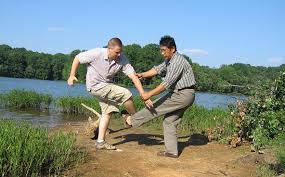 I think that once you can integrate these aspects in your two person training you can integrate them into your forms and solo work. The focus of the intention is key to the mind training aspect of the arts, especially during solo practice because you have no outside stimulation.
Just a few more ideas about training intent...
Intent at different levels of intensity:
I can apply my intent at different levels of intensity when training both solo and with a partner. My intent does not have to just blast on. It functions more like the dimmer switch on some lights. I can play my intent light, keeping the level of intensity low so as I do not alert someone to my intentions. I can play in the mid range, clear and in control. I can play my intention at full intensity, overwhelming my opponent with the force of my mind and body.
Use a training partner to develop my intent.
By training with a partner I can see where the proper use of different levels of intention can help me to effectively engage and eliminate my opponent.
Remembering how your body and mind felt when you engaged your partner and plugging that into your solo practice is the next step. Forms help to develop focus. If you know what to focus on and how to do it then this type of training can have great benefit.
Within the Yizong school we train Hebei Xingyiquan, Gao Style Baguazhang and Chen Pan Ling Tajiquan. The differences in intention can be seen in how the arts of Xingyi, Bagua and Taiji are applied. This is not something that you can necessarily see all that well when someone is doing a form, but may be obvious when one is applying their intent towards another person. I would also say that it is very difficult to feel the proper intent in your forms until you have a proper understanding of how it is being applied with resistance. This is why it is so important to train both solo and two person practice. If you do not train both then there is a likelihood that you are missing a piece of the whole.
The majority of my experience in this matter comes from training the Hebei Xingyiquan and Gao Style Baguazhang of the Yizong system taught by Luo Dexiu.
The intent of Xingy is such that it overwhelms an opponent with force. Xingyi is much like a tank; it rolls right through obstacles and simply blasts things that come up against it. Xingyi is well suited for people with a large frame. This could be why it worked so well for masters like Hong Yi Xiang and why he was renown for his tremendous power and skill.
Just a few more ideas about training intent...
Intent at different levels of intensity:
I can apply my intent at different levels of intensity when training both solo and with a partner. My intent does not have to just blast on. It functions more like the dimmer switch on some lights. I can play my intent light, keeping the level of intensity low so as I do not alert someone to my intentions. I can play in the mid range, clear and in control. I can play my intention at full intensity, overwhelming my opponent with the force of my mind and body.
Use a training partner to develop my intent.
By training with a partner I can see where the proper use of different levels of intention can help me to effectively engage and eliminate my opponent.
Remembering how your body and mind felt when you engaged your partner and plugging that into your solo practice is the next step. Forms help to develop focus. If you know what to focus on and how to do it then this type of training can have great benefit.
Tuesday, June 28, 2011
Tuesday, June 21, 2011
Breaking things apart...Part 3
In the last post, solo hand methods were discussed. Now we will go over the body methods and how the solo body methods can be trained.
The hands are very important because they are most often going to be your first point of contact when engaging someone, however without the body the hands have no power. This is why we take great care to train the body and the different ways it can move to express power differently. The houtians are a great training tool for this because they cover many of the different hand/body method combinations that we use in our Yizong Bagua and they are less complicated than the shentien forms. (We will get into the connections between the houtian and shentien parts of Yizong bagua in a separate post later).
When training the body I usually do things two different ways; static/standing and stepping.
As we can see in this video I have separated out the two main body movements that can be done without my feet moving.
One important thing to note. When training the process of breaking my forms down, I want to break things down so that I can understand them more quickly, but I also want to work to get things put back together as quickly as possible. Bagua is about continuous moving power. If I train singular movement over and over, but I never reattach anything to the motion I am doing, then it presents the issue that I am now reliant upon a singular motion or technique. Doing a singular motion without eventually continuing to something else promotes stopping when engaged. The moment we stop moving our vulnerability increases dramatically. We should work to have smooth effortless continuous power in our Bagua. Training things as singular pieces allows me to simplify and 'get' things quicker, but it is critical to start mending all the pieces back together as soon as I begin to feel what the form is designed to express. Once I can do the form continuously, with clarity, relaxation and proper structure, I should seek to find smoothness in doing the form over and over again. Once smoothness has been achieved within the form, it should be linked to other forms to further train the mind and body's ability to change without hindrance.
The hands are very important because they are most often going to be your first point of contact when engaging someone, however without the body the hands have no power. This is why we take great care to train the body and the different ways it can move to express power differently. The houtians are a great training tool for this because they cover many of the different hand/body method combinations that we use in our Yizong Bagua and they are less complicated than the shentien forms. (We will get into the connections between the houtian and shentien parts of Yizong bagua in a separate post later).
When training the body I usually do things two different ways; static/standing and stepping.
As we can see in this video I have separated out the two main body movements that can be done without my feet moving.
- I am focusing on how the drop and circle propels the hooking motion.
- I am focusing on the bend in my body and keeping my back straight
- I am letting the drop and circular hooking motion lead me into my 7-star stance.
- I am feeling the slight push across my body prior to my body folding.
One important thing to note. When training the process of breaking my forms down, I want to break things down so that I can understand them more quickly, but I also want to work to get things put back together as quickly as possible. Bagua is about continuous moving power. If I train singular movement over and over, but I never reattach anything to the motion I am doing, then it presents the issue that I am now reliant upon a singular motion or technique. Doing a singular motion without eventually continuing to something else promotes stopping when engaged. The moment we stop moving our vulnerability increases dramatically. We should work to have smooth effortless continuous power in our Bagua. Training things as singular pieces allows me to simplify and 'get' things quicker, but it is critical to start mending all the pieces back together as soon as I begin to feel what the form is designed to express. Once I can do the form continuously, with clarity, relaxation and proper structure, I should seek to find smoothness in doing the form over and over again. Once smoothness has been achieved within the form, it should be linked to other forms to further train the mind and body's ability to change without hindrance.
Thursday, June 2, 2011
Breaking things apart... Part 2
In my last post I left off talking about forms and how once you are able to do a form with good structure and relaxation you should then seek to play with all the different aspects of body usage that are contained within the form. Sometimes it is actually beneficial to isolate specific ranges of motion being expressed in the form and train those movements to further develop a particular skill.
Isolating specific movements in the form and training them as isolated exercises is a good method for training specific aspects of body usage. This isolation technique is very useful for developing the shoufa (hand methods) and shenfa (body methods).
When training the houtians, we have many different methods being expressed. Methods can be expressed in both the hands and the body independently, but are most effective when expressed together. Sometimes training the two together is difficult at first. It can be useful to separate the hands and the body and develop the difficult area and then bring them back together again. The separation of hand and body methods can be useful if you feel that you are deficient in one area and need to focus on bringing that area up to speed with the other parts.
2. Shou Fa - Hand Methods - solo
Isolation of the hand methods can be a useful tool to help simplify the motion involved with the houtian form. One of the easier ways to do this is to take the main point of expression in the form and doing it from a natural stance, with no stepping involved.
I worked on this the other night with my class when we were doing 1.5 - Li.
What I have done here is isolated the hand movements that are being expressed in the encircling phase of this form. In doing so I am able to simplify my body coordination and focus on my hands alone.
I then shift to doing this with the body drop to work on the timing of my body folding and arms encircling. After this I do one repetition of the form so you can see where it is that the arms encircle and the body drops. As you can see, the forms can be be simplified, layered and reconstructed.
Learning how to train the smooth transition of the hands through space is a critical piece of Baguazhang. Li (1.5) definitely holds true to this! In order for me to properly use the encircling power of Li my arms must move smoothly. For my arms to move smoothly I must train smooth movement which can be difficult if the form is overly complicated. If I can break out the hand method and layer it back in to the form then I may experience more efficient progress in my training.
It is very important to be clear in the hand methods. There are two (and probably more) good reasons behind this.
From a meditative standpoint:
Training with focus on my hands brings the attention of the mind out into the hands. The goal is to keep the intention of the mind very smooth, clear and relaxed in the hands. The hands are most distant from the source of power (the body) and for the hands to be most effective they need to be trained with precision. Sometimes we have a tendency to over project our intent or simply put, just focus a bit too hard, when focusing on hands alone. This is a good place to assess where your level of intent is and decide if you are doing to much. Paying attention to where your mind is.
From a physical standpoint:
From a physical standpoint precision in the hands is critical because the further we get away from the source of power, the more important it is for the structure to be properly placed. If my structure does not have proper placement when pressure is applied then my structure will crumble. Having the hands in the proper shape and placement in relation to the body position is what allows for the efficient transfer of power between the source (you) and your point of contact.
Up next, the body!
Isolating specific movements in the form and training them as isolated exercises is a good method for training specific aspects of body usage. This isolation technique is very useful for developing the shoufa (hand methods) and shenfa (body methods).
When training the houtians, we have many different methods being expressed. Methods can be expressed in both the hands and the body independently, but are most effective when expressed together. Sometimes training the two together is difficult at first. It can be useful to separate the hands and the body and develop the difficult area and then bring them back together again. The separation of hand and body methods can be useful if you feel that you are deficient in one area and need to focus on bringing that area up to speed with the other parts.
2. Shou Fa - Hand Methods - solo
Isolation of the hand methods can be a useful tool to help simplify the motion involved with the houtian form. One of the easier ways to do this is to take the main point of expression in the form and doing it from a natural stance, with no stepping involved.
I worked on this the other night with my class when we were doing 1.5 - Li.
What I have done here is isolated the hand movements that are being expressed in the encircling phase of this form. In doing so I am able to simplify my body coordination and focus on my hands alone.
I then shift to doing this with the body drop to work on the timing of my body folding and arms encircling. After this I do one repetition of the form so you can see where it is that the arms encircle and the body drops. As you can see, the forms can be be simplified, layered and reconstructed.
Learning how to train the smooth transition of the hands through space is a critical piece of Baguazhang. Li (1.5) definitely holds true to this! In order for me to properly use the encircling power of Li my arms must move smoothly. For my arms to move smoothly I must train smooth movement which can be difficult if the form is overly complicated. If I can break out the hand method and layer it back in to the form then I may experience more efficient progress in my training.
It is very important to be clear in the hand methods. There are two (and probably more) good reasons behind this.
From a meditative standpoint:
Training with focus on my hands brings the attention of the mind out into the hands. The goal is to keep the intention of the mind very smooth, clear and relaxed in the hands. The hands are most distant from the source of power (the body) and for the hands to be most effective they need to be trained with precision. Sometimes we have a tendency to over project our intent or simply put, just focus a bit too hard, when focusing on hands alone. This is a good place to assess where your level of intent is and decide if you are doing to much. Paying attention to where your mind is.
From a physical standpoint:
From a physical standpoint precision in the hands is critical because the further we get away from the source of power, the more important it is for the structure to be properly placed. If my structure does not have proper placement when pressure is applied then my structure will crumble. Having the hands in the proper shape and placement in relation to the body position is what allows for the efficient transfer of power between the source (you) and your point of contact.
Up next, the body!
Saturday, May 14, 2011
Breaking things apart...
I have been working heavily on breaking down the different houtian forms lately. There are going to be several posts on this blog as each piece is part of the whole, but can easily by isolated for training purposes.
From my experience, we can break each houtian up in the following ways:
1. Form
2. Shou Fa - Hand Methods - solo
3. Shen Fa - Body Methods - solo
4. Drills - two person exercises designed to train a specific principle/method.
5. Rou Shou - how to apply from a point of contact
6. Application - how to apply from a point of no contact.
For those of you that do not know what the houtian are; there are 64 forms in the Gao style Bagua system, each form is a method for training a specific principle. There are eight different houtian lines and each one contains eight forms, making up the 64. Each one of the lines is more specific to a type of usage than another; ex - hitting, kicking, elbows, subtlety, cleverness... Okay, now that we have that laid out we can move on...
From my experience, we can break each houtian up in the following ways:
1. Form
2. Shou Fa - Hand Methods - solo
3. Shen Fa - Body Methods - solo
4. Drills - two person exercises designed to train a specific principle/method.
5. Rou Shou - how to apply from a point of contact
6. Application - how to apply from a point of no contact.
For those of you that do not know what the houtian are; there are 64 forms in the Gao style Bagua system, each form is a method for training a specific principle. There are eight different houtian lines and each one contains eight forms, making up the 64. Each one of the lines is more specific to a type of usage than another; ex - hitting, kicking, elbows, subtlety, cleverness... Okay, now that we have that laid out we can move on...
1. Form
I have been breaking things up in the following way so I can try and extrapolate as much as possible. First I look at the form as a whole and see which parts are the focal points. I call this the step by step or one movement one count. These can be considered as change points or as Luo Dexiu likes to call them, "photo by photo". One of the ways that I learned to do forms was to work on making a relaxed and stable structure in all of these change points and then carry that relaxed and stable structure through each transition to the next change point. Much easier said than done!
As your body and mind relax and get used to the different postures you need to put it all back together. This is where we begin seeing two movements in one count; smoothing things out. Once you have sewn all the pieces back together you can do all of the movements in one count. This is teaching the body to move as a whole unit and changing with structure and power; training to move with efficiency and power. The key thing is to do the forms in a relaxed and stable manner and really play with them in order to make them yours!
Once you are able to do a form with good structure and relaxation you should then seek to play with all the different aspects of body usage that are contained within the form. Isolating specific movements in the form and training them as isolated exercises is a good method for training specific aspects of body usage.This is where I will pick up next time...
Friday, April 22, 2011
Play!
Last night in class I really focused of the idea of integrating a playful mindset into our training. This was a theme that carried through the duration of class. From what I have experienced, adding a playfulness to your training allows the body and mind to move more freely and change with less resistance. This play-mind can be used in both solo and partner training and should be heavily emphasized in partner training.
During partner training, I should start with a very deliberate and clear idea of what it is I am trying to do. In the beginning, things should be very mellow and cooperative so that your body and mind are not receiving shock. As the level of intensity increases and the level of cooperation with your partner decreases it become more and more important that you maintain a relaxed and clear mind. This will directly carry over to your body and reduce the amount of shock that you receive. If I train in such a way that my body and mind do not feel that they are being punished then they will be more resilient and open and your my skill will grow.
This can be carried into solo training as well. As my stance work deepens and I put my body through more and more rigorous training, it becomes more important that I remain calm, relaxed, and clear. Intensifying the training can often increase the intensity of ones intent. This is fine so long as you don't let that intensity restrict your ability to exercise fluid relaxed change.
During partner training, I should start with a very deliberate and clear idea of what it is I am trying to do. In the beginning, things should be very mellow and cooperative so that your body and mind are not receiving shock. As the level of intensity increases and the level of cooperation with your partner decreases it become more and more important that you maintain a relaxed and clear mind. This will directly carry over to your body and reduce the amount of shock that you receive. If I train in such a way that my body and mind do not feel that they are being punished then they will be more resilient and open and your my skill will grow.
This can be carried into solo training as well. As my stance work deepens and I put my body through more and more rigorous training, it becomes more important that I remain calm, relaxed, and clear. Intensifying the training can often increase the intensity of ones intent. This is fine so long as you don't let that intensity restrict your ability to exercise fluid relaxed change.
Subscribe to:
Posts (Atom)